> For the complete documentation index, see [llms.txt](https://docs.wellcomecollection.org/transcribe-wellcome/llms.txt). Markdown versions of documentation pages are available by appending `.md` to page URLs; this page is available as [Markdown](https://docs.wellcomecollection.org/transcribe-wellcome/research/people/private-collectors/french-sheldon-may.md).

# French-Sheldon, May

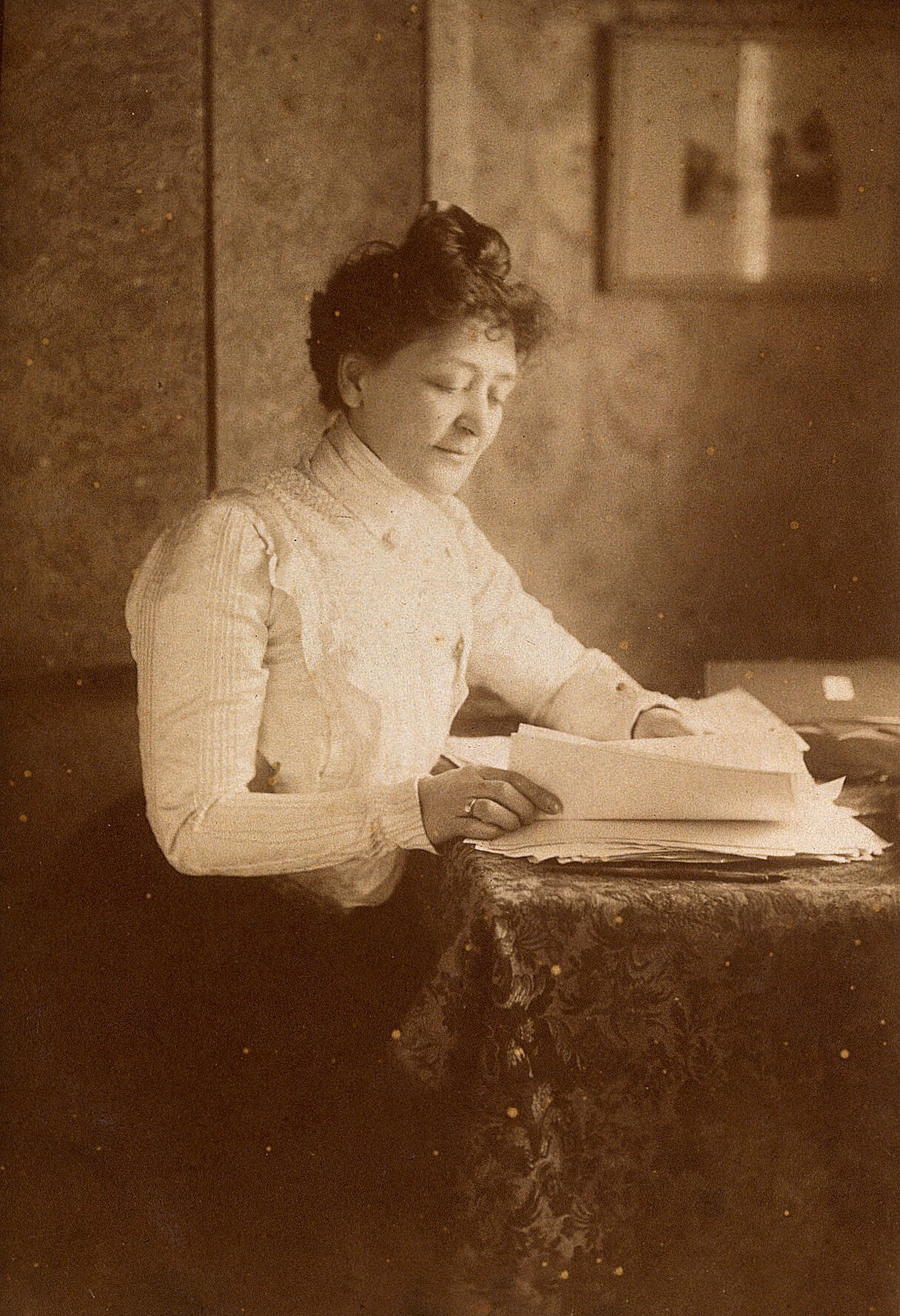
<div align="center"><figure><img src="https://iiif.wellcomecollection.org/image/V0027802EL/full/full/0/default.jpg" alt=""><figcaption><p><a href="https://wellcomecollection.org/works/y6qcjhgg">May French Sheldon. Photograph by Elliott &#x26; Fry.</a></p></figcaption></figure></div>

May French was born in 1847 in rural Pennsylvania outside of Pittsburg. She traveled extensively in her youth, and received some holistic medical training from her mother. In 1870, she married Eli Lemon Sheldon, a lawyer and investment banker. The couple soon moved to London and created a large social network, often hosting salon-like gatherings at their home. Among the visitors to their home included Sir Henry Wellcome and the famous explorer Henry Morton Stanley. It seems as if these adventurers encouraged May’s first trip to eastern Africa in 1891. Through this trip, she fashioned herself as “Lady Stanley” or “Bebe Bwana” (White lady) and claimed the role as the first woman explorer in Africa. Soon after this trip, Eli Sheldon suddenly died. May lived with Nellie Butler. While no longer a hub for social circles, French-Sheldon maintained a middleclass life style, thanks to financial support from Wellcome and others, and kept herself in public view by giving lectures about her travels. As a solo female traveler, French-Sheldon also became a kind of spokeswoman for early feminist causes, advocating for women’s place in exploratory missions.&#x20;

<figure><img src="https://iiif.wellcomecollection.org/image/L0023277/full/full/0/default.jpg" alt=""><figcaption><p><a href="https://wellcomecollection.org/works/exj8e3un">Mrs. French Sheldon's Palanquin.</a></p></figcaption></figure>

In 1903, William E. Stead, co-founder of the Congo Reform Association commissioned her to travel to Congo. Stead intended May to discover conditions in Congo that would undermine Belgian King Leopold II’s reputation. Stead’s plans backfired when Sheldon’s report presented a view sympathetic to King Leopold’s agenda and supporting colonialisms endeavors to “bring civilization” of the Congo. Letters from anti-colonial missionaries and others who witnessed French-Sheldon’s trip stated that she clearly had a curated experience, seeing only what colonial officials wanted her to see, and even denying an opportunity to venture of the beaten path, so to speak, and to witness some of the atrocities and mis-treatments that were so characteristic of King Leopold’s regime.&#x20;

<figure><img src="https://iiif.wellcomecollection.org/image/L0044676/full/full/0/default.jpg" alt=""><figcaption><p><a href="https://wellcomecollection.org/works/jgdzbfun">Roger Casement and Mrs French Sheldon.</a> On the back of this photograph is written 'Roger Casement and Mrs French Sheldon - Casement declaring that Germany would take and rule the Congo. Photograph by W.L. Royburgh, 1904'. The letters W.H.M.M, are also stamped onto the front and back of the photograph</p></figcaption></figure>

French-Sheldon's acclaim dwindled as she became older. But she did remain active and was later on staff at the Wellcome Historical Medical Museum. She died in 1936, just before her eighty-ninth birthday. Much of French-Sheldon's archives and collection was later dispersed by relatives of Nellie Butler—now in the collection of the British Museum (UK), the Smithsonian National Museum of Natural History (US), Museum of Applied Arts and Sciences (Australia), Africa Museum (Belgium), and the Fowler Museum at UCLA. Her personal papers are kept at the [Library of Congress](<https://www.loc.gov/item/mm78039677/ >) (deposited by Ann Butler), the Wellcome Archives, and the [Africa Museum](https://archives.africamuseum.be/repositories/5/archival_objects/10195)\[CSF2] \[CSF3] .

<figure><img src="https://iiif.wellcomecollection.org/image/V0027801/full/full/0/default.jpg" alt=""><figcaption><p><a href="https://wellcomecollection.org/works/cunzpak9">May French Sheldon.</a></p></figcaption></figure>

**Wellcome Collection References**

[WA/HMM/CO/Chr/H.13 ](https://wellcomecollection.org/works/f8qcwjck)

[WA/HMM/CO/Sai/A.28 ](https://wellcomecollection.org/works/j7k32xvr)

[WA/HMM/CM/Col/92](https://wellcomecollection.org/works/q35hcfpf)&#x20;

WF.M.I.PR.E48&#x20;

[WA.HSW.PH.J.2 ](https://wellcomecollection.org/works/sy94ab6k)&#x20;

WA.HSW\.CO.Ind.A.6&#x20;

[WA/HMM/ST/Lat/A.78](<https://wellcomecollection.org/works/jqjrmrrd >) &#x20;

**References:**

Boisseau, Tracey Jean. *White Queen: May French-Sheldon and the Imperial Origins of American Feminist Identity.* Bloomington: Indiana University Press, 2004.&#x20;

&#x20;Burroughs, Robert. “The travelling apologist: May French Sheldon in the Congo Free State (1903–04)” *Studies in Travel Writing* 14, no. 2 (2010): 135-157, DOI:10.1080/13645141003747231

Marchal, Julies. *E.D. Morel Contre Léopold II: L’histoire du Congo 1900-1910.* Vol. 1. Paris: L’Harmattan, 1996. Pages: 303-310.

&#x20;Newman, Louise Michele. *White Women’s Rights: The Racial Origins of Feminism in the United States.* Oxford: Oxford University Press, 1999 (Particularly chapter 4: “A Feminist Explores Africa: May French-Sheldon’s Subversion of Patriarchal Protection, pages 102-115)

&#x20;


---

# Agent Instructions
This documentation is published with GitBook. GitBook is the documentation platform designed so that both humans and AI agents can read, navigate, and reason over technical content effectively. Learn more at gitbook.com.

## Querying This Documentation
If you need additional information that is not directly available in this page, you can query the documentation dynamically by asking a question.

Perform an HTTP GET request on the current page URL with the `ask` query parameter, and the optional `goal` query parameter:

```
GET https://docs.wellcomecollection.org/transcribe-wellcome/research/people/private-collectors/french-sheldon-may.md?ask=<question>&goal=<endgoal>
```

`ask` is the immediate question: it should be specific, self-contained, and written in natural language.
`goal` is optional and describes the broader end goal you are ultimately trying to accomplish on behalf of the user. GitBook uses it to tailor the answer towards what is most useful for that goal.

The response will contain a direct answer to the question and relevant excerpts and sources from the documentation.

Use this mechanism when the answer is not explicitly present in the current page, you need clarification or additional context, or you want to retrieve related documentation sections.
